

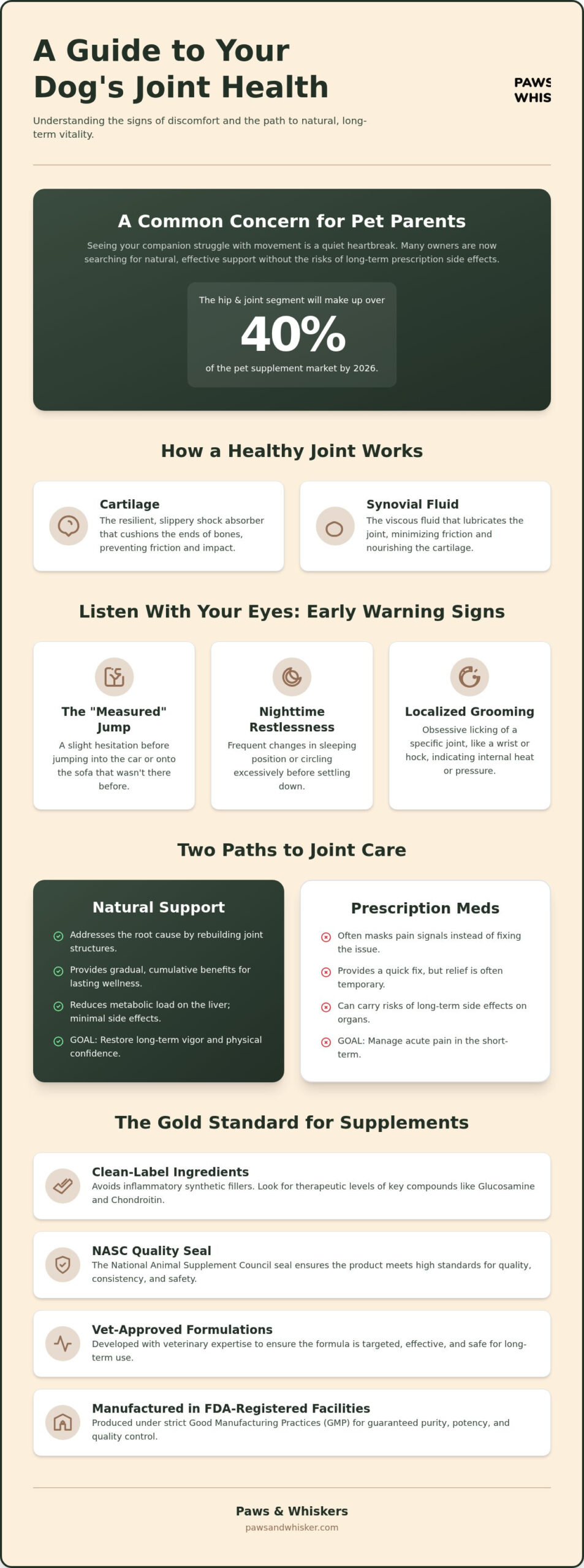
You notice the slight hesitation at the base of the stairs, a silent pause where there used to be a joyful leap. It’s a quiet heartbreak to see your most loyal companion struggle with the simple mechanics of movement, especially when you aren’t sure which path to take. You aren’t alone in this worry. With the hip and joint segment now making up over 40 percent of the pet supplement market in 2026, many owners are searching for natural joint support for dogs that actually works without the risks of long-term prescription side effects.
We understand the confusion that comes with complex ingredient labels and the deep desire to protect your dog’s organic well-being. This guide will show you how to identify the subtle, unspoken signs of joint distress and choose clean-label, vet-approved supplements that restore your dog’s physical vigor. We’ll examine the latest clinical data on botanical purity, the significance of the NASC Quality Seal, and how a meticulous, science-backed approach can help your dog move with confidence once again.
Key Takeaways
- Learn to interpret the subtle shifts in your dog’s movement, focusing on stiffness and hesitation rather than just visible pain.
- Understand the biological role of cartilage and synovial fluid in maintaining the essential “cushioning” mechanism for fluid mobility.
- Discover how to navigate the complexities of natural joint support for dogs by identifying clean-label ingredients that avoid inflammatory synthetic fillers.
- Explore a holistic wellness architecture where intentional movement and science-backed supplementation work together to restore your pet’s physical vigor.
- Gain the confidence to choose vet-approved formulations manufactured in FDA-registered facilities to ensure your dog’s long-term safety and vitality.
Understanding Canine Joint Health: More Than Just Wear and Tear
Movement defines your dog’s life. From the frantic tail wags at the door to the graceful arc of a mid-air catch, their vitality depends on a complex biological architecture. When we talk about natural joint support for dogs, we aren’t just discussing a remedy for old age. We’re talking about a proactive strategy to safeguard the integrity of cartilage and synovial fluid long before the first signs of a limp appear. This is about preservation, not just repair.
Think of your dog’s joints as a sophisticated cushioning system. Cartilage acts as a resilient, slippery shock absorber, while synovial fluid provides the necessary lubrication. While an acute injury happens in a heartbeat, the gradual progression of age-related stiffness is a slow, silent erosion. By embracing a philosophy of “nurturing wellness,” you commit to building joint resilience that helps your companion stay active for years to come. It’s a promise of long-term mobility made today.
The Role of Inflammation in Canine Discomfort
Inflammation is a natural biological response, but when it becomes chronic, it begins to target and break down healthy joint tissues. This cycle of irritation leads to the degradation of the very structures that allow for fluid movement. Understanding Arthritis is essential here, as the condition often stems from this persistent inflammatory state that wears away at the bone’s protective layers. Synovial fluid is a specialized, viscous liquid that fills the joint space to minimize friction and distribute nutrients to the surrounding cartilage. Suppressing this inflammation through botanical purity allows the body to maintain its internal balance without the harsh rebound effects often seen with synthetic interventions.
Why Natural Support is a Strategic Long-Term Choice
Prescription medications often act as a quick fix by masking pain signals, but they rarely address the underlying structural needs of the joint. In contrast, natural nutrients focus on foundational rebuilding. This isn’t an overnight transformation; it’s a cumulative process where benefits accrue over months of consistent care. By choosing clean-label options like Joint Support Chews, you ensure your dog receives therapeutic levels of glucosamine and chondroitin without unnecessary fillers. These pure ingredients also reduce the metabolic load on a senior dog’s liver, which is often already working hard to process the environmental toxins of daily life. This heart-centered approach to natural joint support for dogs prioritizes long-term vigor over temporary relief, ensuring your family member feels as strong on the inside as they look on the outside.
Recognizing the Silent Signs of Joint Stiffness
You know your dog better than any diagnostic tool ever could. It’s that tiny shift in their morning greeting or the way they pause for a heartbeat before tackling the porch steps. As a Wise Caretaker, your intuition is your most powerful asset. While many owners wait for a visible limp to seek help, the most critical window for natural joint support for dogs happens much earlier, during the phase of hidden distress. By shifting your focus from obvious pain to subtle hesitation, you can intervene while their body still has the resilience to bounce back.
Subtle Behavioral Shifts You Might Miss
Dogs are masters of disguise, often hiding their discomfort until it becomes nearly unbearable. This isn’t stubbornness; it’s a deep-seated biological drive. Because dogs instinctively mask pain as a survival mechanism, you must look for changes in their daily rituals rather than listening for a whimper. Watch for these specific behavioral markers:
- The “Measured” Jump: A slight hesitation before jumping into the car or onto the sofa that wasn’t there six months ago.
- Nighttime Restlessness: Frequent changes in sleeping positions or circling excessively before settling down, which suggests they can’t find a comfortable angle for their hips or spine.
- Localized Grooming: Obsessive licking of a specific wrist or hock, which often indicates the presence of internal heat or pressure within the joint capsule.
The Intuitive Connection: Listening to Your Dog
A sudden decrease in “enthusiasm for the leash” is rarely just a sign of getting older or becoming lazy. It’s a physical signal that the walk has transitioned from a source of joy to a source of exertion. According to Cornell’s Guide to Canine Osteoarthritis, these early shifts in activity levels are often the first clinical indicators of a degenerative process that requires a nurturing intervention.
Observe your dog’s gait on different surfaces. If they walk confidently on the soft grass but move gingerly or “skate” on hard kitchen tiles, their joints are likely struggling to manage the impact of firm ground. Catching these whispers of discomfort allows you to provide natural joint support for dogs before the cycle of inflammation leads to chronic degradation. If you’ve started to notice these quiet changes in your companion’s movement, introducing clean-label joint support can help protect their organic well-being and restore their natural vigor.
Evaluating Ingredients: Clean Labels vs. Synthetic Fillers
Purity isn’t just a marketing buzzword; it’s a clinical necessity for senior pets. When you search for natural joint support for dogs, you’ll find thousands of options, but only a fraction prioritize “clean label” standards. A clean label represents a commitment to transparency and botanical purity, ensuring that every ingredient serves a specific biological purpose. Many commercial options rely on inexpensive fillers like corn, soy, or wheat. These ingredients don’t just provide empty calories; they can inadvertently trigger the very inflammatory response you’re trying to soothe.
By choosing biologically appropriate ingredients, you ensure your dog’s body can actually utilize the nutrients provided. This is why vet-approved formulations are essential. Professionals understand the delicate balance of nutrient ratios, ensuring that one ingredient doesn’t inhibit the absorption of another. Our Joint Support Chews are manufactured in US-based, FDA-registered facilities to maintain these rigorous standards of safety and efficacy.
The Science of Glucosamine, Chondroitin, and Omega-3s
The most effective supplements rely on a synergistic relationship between key active compounds. Glucosamine plays a vital role in cartilage repair by providing the building blocks for the structural matrix. Chondroitin acts like a molecular sponge, drawing moisture into the joints to maintain the fluid “cushioning” necessary for movement. Adding Salmon Oil to this regimen introduces potent Omega-3 fatty acids, which provide a natural anti-inflammatory effect that complements the structural work of glucosamine.
The source of these ingredients matters deeply for dogs with sensitivities. While shellfish-derived glucosamine is highly bioavailable and effective, some dogs may require bovine-sourced alternatives if they have specific allergies. Always look for brands that specify the origin of their ingredients to ensure you’re making the safest choice for your family member’s unique biology.
Avoiding the “Dirty Dozen” in Dog Supplements
Reading a supplement label like a clinical expert requires looking past the flashy front packaging. Watch out for the “Dirty Dozen” of synthetic additives, particularly chemical preservatives like BHA and BHT. These compounds are often used to extend shelf life, but they can place an unnecessary metabolic load on a senior dog’s liver. You should also be wary of “hidden sugars” like molasses or corn syrup, which are frequently used to make soft chews more palatable but can contribute to weight gain and systemic inflammation.
According to the AKC on Osteoarthritis Management, maintaining a healthy weight is a cornerstone of joint health. Artificial flavors and dyes serve no nutritional purpose and only increase the risk of adverse reactions. A truly effective natural joint support for dogs will rely on high-quality, recognizable ingredients that prioritize your pet’s long-term vitality over manufacturing convenience.
A Holistic Framework for Restoring Canine Vigor
Restoration is a journey, not a destination. While providing high-quality natural joint support for dogs offers the essential building blocks for repair, these nutrients work best within a broader wellness architecture. Think of supplementation as one pillar in a structure that also requires thoughtful movement, weight management, and a supportive home environment. When you align these elements, you create a nurturing space where physical recovery can truly take root, allowing your companion to regain their natural physical vigor.
Movement is medicine, but the dosage and type must be carefully calibrated. For a dog experiencing joint stiffness, the goal shifts from high-intensity exertion to consistent, gentle engagement. This approach respects their body’s current limits while encouraging the circulation of synovial fluid, which we previously identified as the joint’s vital lubricant. By nurturing their environment and lifestyle, you act as a Wise Caretaker who prioritizes long-term resilience over temporary fixes.
Low-Impact Exercise and Weight Management
High-impact activities like chasing a ball or jumping for a frisbee can create significant torque on compromised joints. Instead, consider the “sniffari,” a slow, steady walk where the primary goal is olfactory stimulation rather than distance. This provides mental enrichment and light physical activity without the jarring impact of sudden stops. Swimming remains the ultimate non-weight-bearing therapy, allowing for a full range of motion without any gravitational pressure on the hips or elbows.
The link between body weight and joint pressure is undeniable. Clinical observations suggest that losing just 5 percent of excess body weight can significantly reduce the load on a dog’s joints, often resulting in a visible improvement in mobility. For a 50-pound dog, a loss of just 2.5 pounds can be the difference between struggling to stand and rising with ease. Pairing a calorie-conscious diet with natural joint support for dogs ensures that every step they take is as effortless as possible.
Creating a Joint-Friendly Home Environment
Your home’s layout plays a silent but critical role in your dog’s physical comfort. Hardwood or tile floors can act like ice rinks for a dog with reduced grip, leading to “splay” injuries that strain the adductor muscles and stress the hip joints. Strategic placement of non-slip rugs or yoga mats provides the traction they need to navigate the house with confidence. This simple environmental adjustment reduces the daily micro-trauma caused by slipping.
- Orthopedic Bedding: High-density memory foam supports spinal alignment and prevents the joints from bottoming out against the hard floor.
- Elevated Feeding Bowls: Raising food and water to chest height can reduce the strain on the neck and forelimbs, though it is important to consult your vet regarding bloat risks for certain breeds.
- Ramps and Steps: Eliminating the need to leap onto the sofa or into the car preserves the integrity of the cartilage over time.
By addressing these environmental factors, you provide the physical support necessary for your dog to thrive. To complement these lifestyle changes and give your senior companion the clinical-grade nutrients they deserve, consider integrating our Joint Support Chews into their daily ritual for comprehensive, science-backed care.
Choosing the Right Support for Your Dog’s Vitality
Being a Wise Caretaker means looking beyond the glossy packaging and into the heart of how a supplement is actually crafted. You’ve learned to spot the silent signs of distress and understand the biological need for structural repair. Now, the final step in this journey is choosing a partner that shares your commitment to organic well-being and scientific integrity. Selecting natural joint support for dogs shouldn’t feel like a gamble; it should feel like a clinical-grade promise to the family member who relies on you for their quality of life.
At Paws & Whiskers, we view ourselves as mission-driven advocates for animal health. We don’t just sell products. We provide a sophisticated blend of empathy and evidence designed to move your dog from a state of hesitation back into a life of physical vigor. By prioritizing transparency and botanical purity, we ensure that every chew you provide is a step toward restoration, backed by the rigorous standards of modern veterinary science.
The Paws & Whiskers Quality Standard
Purity starts in the laboratory and ends in the bowl. Our Joint Health Soft Chews undergo a meticulous vet-approval process to ensure that every nutrient ratio is clinically optimized for senior dog mobility. Unlike many commercial options that hide behind vague “holistic” claims, our formulations are manufactured in US-based, FDA-registered facilities that adhere to strict Good Manufacturing Practices (GMP). This provides the peace of mind that your dog’s supplement is free from contaminants and accurately labeled.
We’ve intentionally excluded corn, wheat, and soy from our recipes. These common fillers are known triggers for systemic inflammation, which can counteract the benefits of the active ingredients. To ensure your dog never experiences a gap in their support, we offer a convenient subscription model. Consistency is the secret to cumulative health, and a steady supply of clean-label nutrients is essential for maintaining the integrity of the joint capsule over the long term.
Starting the Path to Restoration
Introducing a new supplement to a sensitive stomach requires a gentle touch. We recommend starting with half the suggested dose for the first week, allowing your dog’s digestive system to acclimate to the concentrated botanical ingredients. This nurturing approach minimizes the risk of upset while the body begins to absorb the building blocks of cartilage repair. Restoration is a gradual unfolding of physical capability, and it’s helpful to track progress through a specific timeline:
- The First 30 Days: This is the loading phase where nutrients begin to saturate the tissues and the initial inflammatory response starts to quiet.
- 60 Days of Use: You’ll likely notice a subtle return of “enthusiasm for the leash” and a reduction in morning stiffness as the synovial fluid reaches optimal viscosity.
- 90 Days and Beyond: This is where the cumulative benefits manifest as visible vigor, characterized by easier movement and a renewed ability to navigate the home environment.
You aren’t just buying a supplement; you’re joining a community of proactive pet parents who prioritize affection and global care as much as they do efficacy. Start the restoration journey today and give your loyal companion the strength they need to stay by your side, active and comfortable, for all the years to come.
Restoring the Joy of Movement Together
Your dog’s vitality shouldn’t be defined by their age. By learning to interpret the silent whispers of stiffness and embracing a holistic wellness architecture, you’ve taken the first step toward reclaiming their physical vigor. You now understand that clinical efficacy is inseparable from botanical purity. Choosing natural joint support for dogs requires a commitment to transparency that avoids the inflammatory burden of synthetic fillers. This heart-centered approach ensures your companion receives only what their body can truly use.
We’re here to support you in this journey of restoration. Our formulas are meticulously prepared in FDA-registered US facilities to ensure the highest standards of safety and strength. You can feel confident providing a vet-approved, clean-label solution that prioritizes your family member’s organic well-being. It’s time to replace hesitation with joy and watch your companion move with confidence once again. Nurture your dog’s mobility with our Vet-Approved Joint Health Soft Chews. Your dog is an integral part of your life story, and they deserve the very best care you can provide.
Frequently Asked Questions
Can I give my dog joint supplements even if they aren’t showing signs of pain?
Yes, starting a regimen before visible pain appears is a cornerstone of proactive wellness. Many breeds are genetically predisposed to structural wear, so providing natural joint support for dogs early helps maintain cartilage density. Think of it as an investment in their future mobility. By the time a dog limps, the inflammatory process is often well advanced. Early intervention preserves the synovial fluid’s viscous quality and supports long-term physical vigor.
What is the best natural ingredient for dog joint support?
While no single ingredient acts alone, a combination of Glucosamine, Chondroitin, and MSM offers the most comprehensive support. Glucosamine provides the essential building blocks for cartilage repair, while Chondroitin helps the joint capsule retain vital moisture. When you pair these with Omega-3s from salmon oil, you create a synergistic effect that addresses both structural integrity and the inflammatory response. This multi-functional approach is far more effective than relying on a single botanical extract.
How long does it take for natural joint supplements to work in dogs?
You should expect to see meaningful changes within 30 to 60 days of consistent daily use. Natural supplements work through a process of cellular saturation rather than the instant masking of symptoms. During the first month, the nutrients begin to accumulate in the joint tissues. By the second month, most owners report a visible return of enthusiasm for walks. The full restorative benefits typically manifest by the 90-day mark as the internal environment stabilizes.
Are there any side effects to natural joint supplements for dogs?
Adverse reactions are rare, though some dogs may experience mild digestive upset when first introducing concentrated nutrients. Choosing a clean-label formula without synthetic fillers or artificial dyes significantly reduces the risk of metabolic strain. If your dog has a sensitive stomach, starting with a half-dose helps their system acclimate. Always monitor for signs of lethargy or unusual bowel changes; however, most pets tolerate these botanical ingredients exceptionally well when they’re formulated with clinical precision.
Can I use human glucosamine for my dog?
It’s best to avoid human-grade supplements because they aren’t calibrated for canine biology. Human products often contain additives like xylitol or certain sweeteners that are toxic to dogs. Additionally, the ratios of active ingredients are designed for a human’s metabolic rate and body weight. Using a vet-approved supplement ensures your dog receives the precise concentration of nutrients they need without the danger of accidental poisoning or ineffective dosing that doesn’t meet their specific needs.
What happens if I stop giving my dog their joint supplement?
If you discontinue the supplement, the protective benefits will gradually fade as the nutrients leave your dog’s system. Because natural joint support for dogs relies on cumulative saturation, stopping the daily dose allows the underlying inflammatory process to resume. You’ll likely notice a return of morning stiffness or hesitation on the stairs within a few weeks. Consistency is the key to maintaining the “cushioning” effect that allows for fluid, pain-free movement throughout their senior years.
Is it better to use a powder, liquid, or chewable joint supplement?
Soft chews are generally the most effective choice because they ensure precise dosing and high palatability. In 2026, chewable supplements hold a 43.84 percent market share because they transform a clinical requirement into a joyful daily ritual. While liquids and powders can be messy or unevenly distributed in food, a chewable ensures your dog receives the full therapeutic dose every time. This consistency is vital for maintaining steady nutrient levels in the bloodstream for optimal recovery.
How do I know if my dog’s joint issues require a vet visit instead of just supplements?
You should consult a veterinarian if your dog experiences sudden lameness, heat in the joints, or vocalizes when touched. While supplements are excellent for managing age-related stiffness, they aren’t a replacement for medical care in cases of acute injury or severe neurological issues. If your pet completely refuses to stand or shows a rapid decline in coordination, a professional diagnostic evaluation is necessary to rule out fractures or ligament tears that require immediate clinical intervention.
Disclaimer
The information provided in this article is for educational and informational purposes only and is not intended as veterinary advice. Every dog is unique, and health concerns should be discussed with a licensed veterinarian. Always consult your veterinarian before introducing new supplements, changing your dog's diet, or beginning any health or wellness program, particularly if your dog has a medical condition, is pregnant or nursing, or is taking prescription medications.