

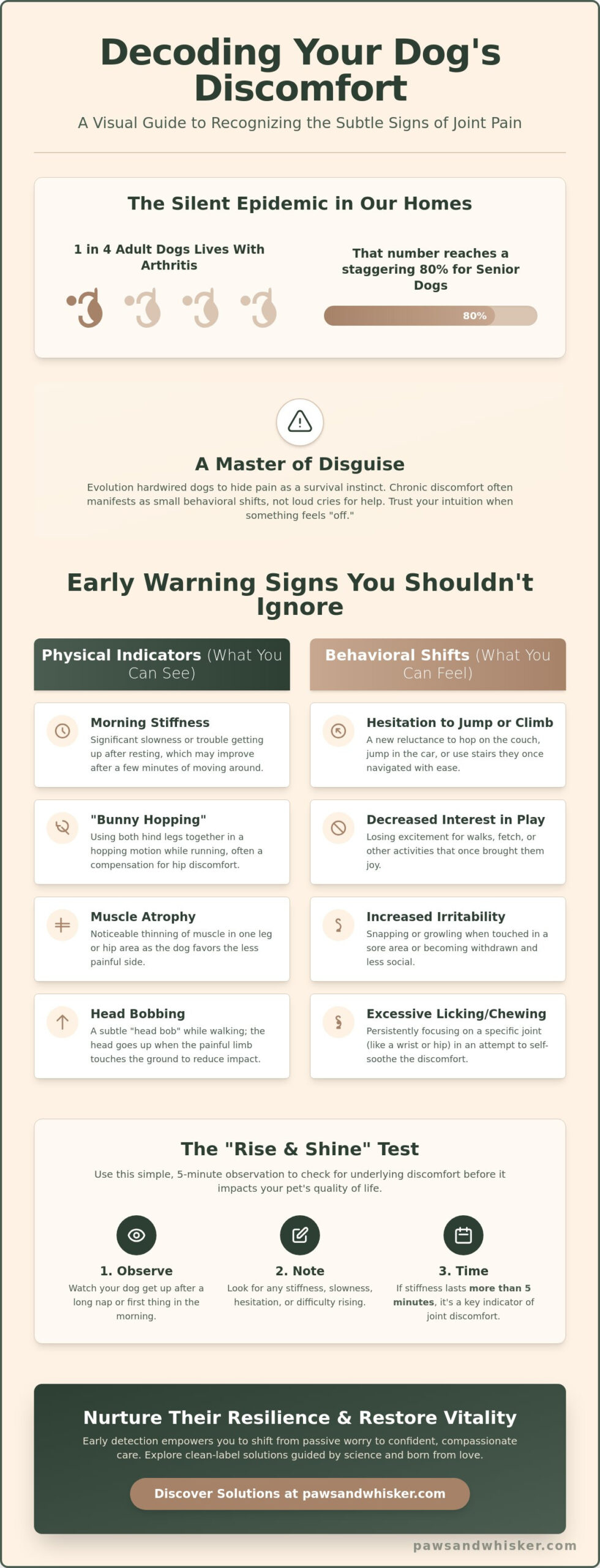
At least one in four adult dogs in the US currently lives with the quiet burden of arthritis; for senior dogs, that number reaches a staggering 80%. It’s a heavy statistic for any pet parent to carry, especially when wagging tails hide real struggles from those who love them most. You might find yourself watching your companion hesitate at the foot of the stairs, wondering if they’re simply slowing down with age or experiencing the first signs of dog joint pain. It’s natural to feel a pang of guilt or confusion, particularly as routine vet visits now average $214 and medical jargon often feels clinical and cold.
We believe your pet’s wellness journey should be guided by science and born from love. This guide will help you decode the subtle behavioral micro-shifts that signal your dog’s discomfort, moving you from uncertainty to a place of confident, compassionate care. You’ll learn how to distinguish normal aging from treatable issues and discover actionable ways to support their mobility at home. From understanding the latest 2026 clinical breakthroughs to choosing pure, clean-label solutions, we’ll show you how to nurture your dog’s resilience and restore their natural vitality.
Key Takeaways
- Learn why your dog’s instinct to hide discomfort makes identifying subtle behavioral shifts crucial for early intervention.
- Discover how to use the “Rise and Shine” test to accurately spot the early signs of dog joint pain before they impact your pet’s quality of life.
- Understand the vital difference between developmental genetics and degenerative wear to better navigate your dog’s unique wellness journey.
- Explore how a holistic blend of clean-label ingredients and scientific innovation can help restore your companion’s natural vitality and joy.
Beyond “Slowing Down”: The Silent Language of Canine Joint Discomfort
Many pet parents watch their companions hesitate at the porch steps and sigh, thinking their friend is simply “getting old.” This perspective, while common, often overlooks the reality that “slowing down” is rarely a choice made by a dog’s spirit. Instead, it’s a physical boundary set by discomfort. We must view these changes as manageable health signals rather than an unchangeable end to their active years. By recognizing the early signs of dog joint pain, you step into your role as a Wise Caretaker, acting as the first line of defense in your pet’s wellness journey. With veterinary prices rising faster than inflation in 2025, identifying these signals early is both an emotional and financial necessity for the modern pet family.
Why Dogs Mask Their Discomfort
Evolutionary biology has hardwired our dogs to be masters of disguise. In the wild, showing vulnerability or physical weakness invited unwanted attention from predators or social displacement within the pack. This survival mechanism means that while a sharp yelp indicates acute injury, chronic pain often remains a silent struggle. You won’t always hear a cry; you’ll see a micro-shift in how they carry their weight or a subtle change in their morning routine. Conditions like Canine hip dysplasia can begin silently in a dog’s youth, only manifesting as visible stiffness years later. Trust your intuition when something feels “off.” You know the rhythm of your dog’s life better than anyone else. Look for these subtle behavioral shifts:
- Morning stiffness that lingers for more than five minutes after waking.
- Shifting weight from one paw to another while standing at the food bowl.
- A new, quiet reluctance to join you for errands or hop into the car.
The Emotional Toll of Mobility Loss
When a dog’s physical world shrinks, their mental world often follows. A dog who can no longer jump onto the sofa to snuggle or keep up on a favorite trail may become withdrawn or irritable. This isn’t a loss of love; it’s a loss of engagement caused by physical limitation. Resilience is built on the ability to move freely, and when mobility fades, the spark of vitality often dims with it. Canine joint inflammation occurs when the protective synovial fluid within the joint capsule thins and loses its lubricating properties, leading to increased friction and progressive tissue damage. Restoring this balance is about more than just movement. It’s about bringing back the joy of a wagging tail that isn’t hiding a struggle. Our mission is born from love and guided by science, ensuring that your journey together remains one of hope and restoration.
Behavioral vs. Physical: Identifying the Early Warning Signs of Dog Joint Pain
While a pronounced limp is impossible to ignore, the earliest signs of dog joint pain are often much quieter. They live in the micro-adjustments your dog makes to stay comfortable throughout the day. Pain is a thief. It steals the joy of a morning walk and replaces a confident stride with a hesitant, guarded gait. Because dogs are biologically programmed to hide vulnerability, you must look for the physical and emotional breadcrumbs they leave behind. Identifying these shifts early allows you to act as a wise caretaker, shifting the narrative from decline to restoration.
Physical Indicators You Can See
One of the most telling physical markers is the “warm-up” effect. You might notice your dog is exceptionally stiff after a long nap or first thing in the morning, yet they seem to move more freely after five or ten minutes of activity. This happens because movement helps circulate joint fluid, temporarily masking the underlying discomfort. Watch for “bunny hopping” during a trot, where both back legs move together. This is a common compensation for hip issues. According to Cornell University on osteoarthritis, physical changes can also include muscle atrophy. If you look down at your dog’s hips and notice one side appears thinner or less muscular than the other, they’re likely offloading weight to a “good” leg. A subtle “head bob” while walking is another red flag; they’ll throw their head up when the painful limb hits the ground to reduce the impact.
Behavioral Shifts You Can Feel
Behavioral changes often precede physical ones. A dog who was once the first at the door for a walk might now linger in their bed, or they may lose interest in a favorite game of fetch after only two or three tosses. You might also notice a “grumpy” shift in personality. If your normally sweet companion growls or pulls away when you pet their lower back, it’s not a sudden lack of affection. It’s a plea for space because that area is tender. Chronic stress from pain can even impact appetite, as the energy required to stand at a bowl becomes too taxing. Nurturing their resilience starts with this awareness, often followed by a transition to natural joint support chews to help maintain daily comfort.
Pay close attention to grooming and sleeping habits. Dogs often lick or chew at specific joints, much like we might rub a sore shoulder, seeking the release of soothing endorphins. Their sleeping patterns may also change. If your dog suddenly avoids their favorite hard-floor cooling spot in favor of a rug, or if they pace restlessly at night because they can’t find a comfortable position, their joints are likely calling for help. These aren’t just quirks of aging; they’re the silent language of discomfort waiting for your response.
Developmental vs. Degenerative: Why Breed and Age Impact Joint Health
Understanding why your dog is struggling requires looking beyond the surface symptoms. Joint issues generally fall into two categories: developmental, which are often present from a young age due to genetics, and degenerative, which result from the steady breakdown of protective structures over time. While the signs of dog joint pain may look similar in both cases, the underlying cause determines how we nurture their recovery. Whether your companion is a playful puppy or a dignified senior, their breed and lifestyle play a starring role in their mobility story.
The Role of Genetics in Puppyhood
For many large breed puppies, the foundation of their joint health is laid long before they take their first steps. Genetics can predispose certain “at-risk” breeds, such as Labradors, German Shepherds, and Rottweilers, to structural abnormalities. Hip dysplasia is defined as a structural mismatch between the ball and socket joints, where the two components don’t fit or develop properly. This mismatch causes painful friction that eventually leads to permanent damage. Because these breeds grow so rapidly, they require specific nutritional support and vet-approved growth monitoring to ensure their skeleton develops in harmony with their muscle mass. Proactive care during these formative months can significantly delay or even prevent the onset of discomfort later in life.
The Wear-and-Tear of a Life Well-Lived
Degenerative issues are the result of years spent chasing balls, jumping for treats, and exploring trails. This process involves the gradual thinning of cartilage and the loss of natural lubrication within the joint capsule. When this protective cushion wears away, bone begins to rub against bone, triggering the inflammation and stiffness we often associate with “old age.” Early intervention is far more effective than late-stage rescue treatments, as it’s easier to preserve existing cartilage than to manage a joint that has already reached severe breakdown. Expert guidance on managing osteoarthritis in dogs emphasizes that movement and weight management are vital pillars of long-term health.
Weight is perhaps the most significant environmental factor we can control. Every extra pound your dog carries puts a disproportionate amount of stress on their frame. In fact, obesity doesn’t just add physical pressure; it also creates a state of low-grade systemic inflammation that can accelerate the signs of dog joint pain and cartilage decay. Keeping your dog at an ideal weight can extend their active years and reduce the severity of symptoms, ensuring their wellness journey remains a joyful one. By acting as a wise caretaker now, you’re protecting the resilience and vitality they’ll need for a lifetime of shared adventures.
The Wise Caretaker’s Checklist: How to Assess Your Dog’s Mobility at Home
Becoming an advocate for your pet means looking beyond the surface. While a vet visit is essential, you’re the one who sees the daily nuances of your dog’s life. By gathering real-world data at home, you provide your veterinarian with the evidence they need to create a precise care plan. This checklist is designed to help you identify the signs of dog joint pain during the moments that matter most, transforming your observations into a roadmap for restoration.
Step 1: The “Rise and Shine” Observation. Watch your dog as they wake up from a long nap. A healthy dog should transition from lying down to standing in under 10 seconds. If your companion takes longer, or if they need to “prop” themselves up using their front legs first while their back end lingers, they’re likely experiencing joint stiffness. Step 2: The Stair Test. Stairs act as a natural stress test for a dog’s frame. Pay attention to whether they hesitate at the top or bottom, or if they’ve started taking steps one at a time rather than in a fluid motion. This “single-stepping” often indicates they’re trying to minimize the impact on a specific joint.
Step 3: The Gentle Touch. When your dog is relaxed, run your hands slowly over their hocks, knees, and hips. You’re looking for two things: heat and swelling. If one joint feels noticeably warmer than the surrounding tissue, it’s a sign of active inflammation. Step 4: The Activity Log. Track your walks with a timer. If your dog starts with a brisk pace but begins to lag behind or pant heavily after exactly 15 minutes, you’ve found their current threshold. Documenting these patterns helps you understand their physical limits and ensures you don’t accidentally push them into further discomfort.
Documenting the Struggle
Your smartphone is one of your most powerful diagnostic tools. Dogs often experience a surge of adrenaline at the clinic that masks their pain, a phenomenon known as “vet office syndrome.” Taking a 30-second video of your dog walking on a flat surface or climbing stairs at home provides a transparent look at their true mobility. Note the time of day when symptoms are most prevalent; for many, the cold dampness of early morning is the hardest. If you see a consistent decline, it’s time to explore how Joint Support Chews can help nurture their natural vitality.
When to Consult Your Vet
Distinguishing between chronic progression and an acute injury is vital for your furry family member’s safety. While chronic pain develops over months, an acute injury results in a sudden, non-weight-bearing lameness. With emergency vet visits starting at $150 and potentially exceeding $10,000 for complex surgeries, early intervention is the most compassionate and practical path. Prepare for your visit by listing your observations and asking about clean-label, holistic options. An early diagnosis isn’t just about managing a condition; it’s about reclaiming the resilience your dog needs for a life of joy.
Nurturing Vitality: A Holistic Approach to Restoring Movement and Joy
Identifying the signs of dog joint pain is the beginning of a transformative chapter in your pet’s life. Once you’ve decoded the silent language of their discomfort, the focus shifts from observation to restoration. At Paws & Whiskers, we operate under a philosophy that is “Born from Love, Guided by Science.” This means we don’t just look at the clinical symptoms; we look at the soul of the animal and the bond you share. Restoring vitality requires a holistic approach that pairs high-standard nutritional science with compassionate lifestyle adjustments to ensure your dog’s wellness journey is one of resilience and hope.
The foundation of effective joint support lies in clean-label ingredients that work in harmony with a dog’s biology. Glucosamine and Chondroitin serve as the essential building blocks for cartilage repair, while Omega-3 fatty acids provide a natural, potent way to manage systemic inflammation. Unlike many traditional options that rely on synthetic additives, we prioritize purity. Choosing products manufactured in FDA-registered facilities ensures that every chew meets rigorous safety standards. This professional oversight is critical because your dog deserves the same clinical effectiveness and transparency that you would expect for any other family member.
Born from Love, Guided by Science
Our commitment to natural pet wellness is rooted in the belief that “Love” is the motivation and “Science” is the map. We’ve seen how wagging tails can hide real struggles, which is why our Joint Support Chews are formulated without unnecessary fillers or artificial preservatives. By focusing on bioavailable, pure ingredients, we help nurture the synovial fluid health mentioned earlier in this guide. This isn’t just about masking a symptom; it’s about healing from the inside out and providing the nutritional resilience your dog needs to navigate their senior years with dignity. We believe that a supplement should be a promise of a better tomorrow, crafted with the integrity of a wise caretaker.
Small Steps to Big Changes
While nutrition is a cornerstone of mobility, environmental modifications create the support system your dog needs to thrive. Small changes in your home can lead to significant improvements in their daily comfort. Consider these practical steps:
- Swap hard, cold floors for orthopedic bedding to reduce pressure on sensitive hocks and hips.
- Install ramps or steady steps to help them reach their favorite resting spots without the jarring impact of jumping.
- Switch high-impact fetch sessions for low-impact exercise like swimming or controlled “scent walks” that engage their mind without overtaxing their joints.
These adjustments, combined with targeted nutritional support, create a comprehensive safety net for your companion. You have the power to rewrite their story from one of limitation to one of movement. Nurture your dog’s vitality with Paws & Whiskers Joint Support Chews and take the first step toward reclaiming the joy of a life lived in motion. Made with ❤️ for pets everywhere.
Reclaiming the Joy of Every Step Together
Your dog’s wellness journey is a shared path; you’re the most important advocate they have in this life. By looking past the common myth of “slowing down” and identifying the behavioral micro-shifts we’ve explored, you’re choosing a future defined by movement rather than limitation. Recognizing the subtle signs of dog joint pain allows you to intervene before discomfort becomes a permanent barrier to their happiness. With 80% of senior dogs facing these hidden struggles, your proactive stance is their greatest gift. For multi-pet households, this advocacy extends to all your companions, and Mission Cats In-Home Care can provide the specialized, stress-free support your feline friends need while you focus on your dog’s recovery.
We believe that restoration starts with purity. Our gluten-free Joint Support Chews are formulated with clean-label, natural ingredients to help nurture your pet’s vitality from the inside out. Every batch is manufactured in FDA-registered US facilities, ensuring the scientific integrity your furry family deserves. When wagging tails hide real struggles, you can trust our vet-approved formulas to provide the clinical effectiveness needed for a life of joy. Restore your dog’s mobility with our vet-approved Joint Support Chews and let’s start this healing chapter today. Your companion’s vitality is our mission. Made with ❤️ for pets everywhere.
Frequently Asked Questions
How can I tell if my dog is in pain or just getting old?
Old age is a life stage, while pain is a medical condition that requires active management. If your dog stops jumping on the bed or hesitates before stairs, they aren’t just tired; they’re likely guarding a sore joint. Look for micro-shifts in behavior, such as retreating from social interaction or sleeping in new positions, to distinguish between a natural decline in energy and actual discomfort.
What are the most common signs of arthritis in dogs?
The most common signs of dog joint pain include stiffness after rest, a “bunny hop” gait, and a reluctance to perform once-easy tasks. You might also notice your dog licking specific joints or showing irritability when touched. These indicators signal that the protective cartilage is wearing thin, leading to the inflammation and bone-on-bone friction typical of canine arthritis.
Can I give my dog human joint supplements?
No, you should never give your dog human supplements because the concentrations and ingredients aren’t formulated for canine biology. Some human products contain xylitol, which is highly toxic to dogs even in small amounts. Veterinary-specific chews ensure the correct ratio of Glucosamine and Chondroitin while avoiding additives that could harm your furry family member’s liver or kidneys.
Is it too late to start my senior dog on joint supplements?
It’s never too late to begin a wellness journey for a senior dog because the goal is comfort and resilience at any age. Even in advanced years, targeted support can help maintain the remaining synovial fluid and manage inflammation. Improving their mobility by even a small percentage can significantly restore their engagement with the family and overall mental health.
What breeds are most prone to joint pain?
Large and giant breeds like Golden Retrievers, Great Danes, and German Shepherds carry a higher genetic risk for developmental joint issues. However, smaller breeds like Dachshunds often face spinal joint challenges due to their long frames. Regardless of breed, approximately 25% of all adult dogs will develop some form of joint disease during their lifetime according to 2025 veterinary data.
Does cold weather make dog joint pain worse?
Cold weather frequently exacerbates joint discomfort because changes in barometric pressure cause tissues to expand and contract. This fluctuation puts added pressure on already sensitive nerves within the joint capsule. Keeping your dog warm with a sweater or orthopedic bed during winter months can help mitigate the stiffness that often follows a drop in temperature.
How long does it take for joint supplements to start working?
Most dogs show visible improvement within four to six weeks of consistent supplementation. Because natural ingredients like Omega-3s and Glucosamine work cumulatively, they need time to build up in the system and begin repairing joint structures. You might notice small wins first, like a slightly faster “rise and shine” time in the morning.
Can weight loss help reduce my dog’s joint pain?
Weight loss is one of the most effective ways to reduce joint stress, as even a 10% reduction in body weight can significantly improve lameness. Excess fat isn’t just heavy; it’s metabolically active tissue that releases pro-inflammatory chemicals into the bloodstream. Reducing the load on the joints slows the rate of cartilage breakdown and helps restore your dog’s natural vitality.
Disclaimer
The information provided in this article is for educational and informational purposes only and is not intended as veterinary advice. Every dog is unique, and health concerns should be discussed with a licensed veterinarian. Always consult your veterinarian before introducing new supplements, changing your dog's diet, or beginning any health or wellness program, particularly if your dog has a medical condition, is pregnant or nursing, or is taking prescription medications.