
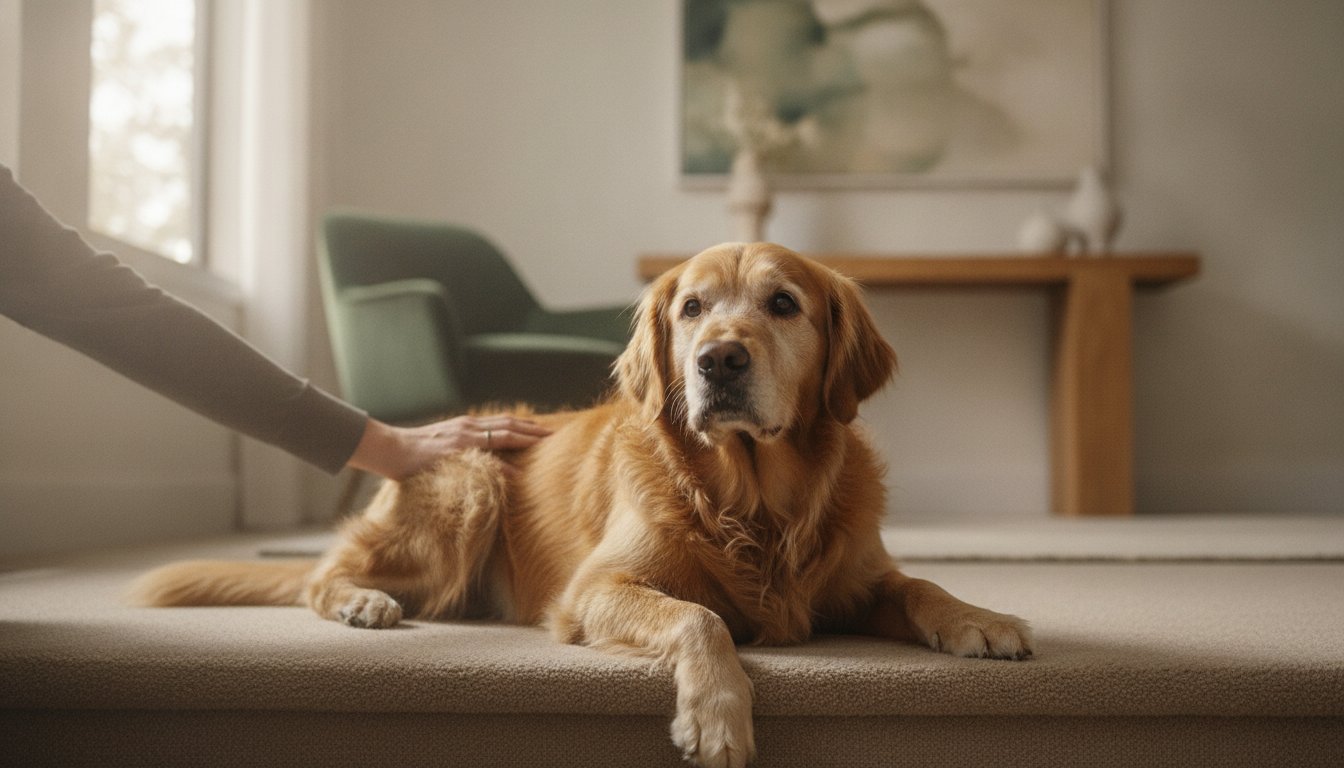
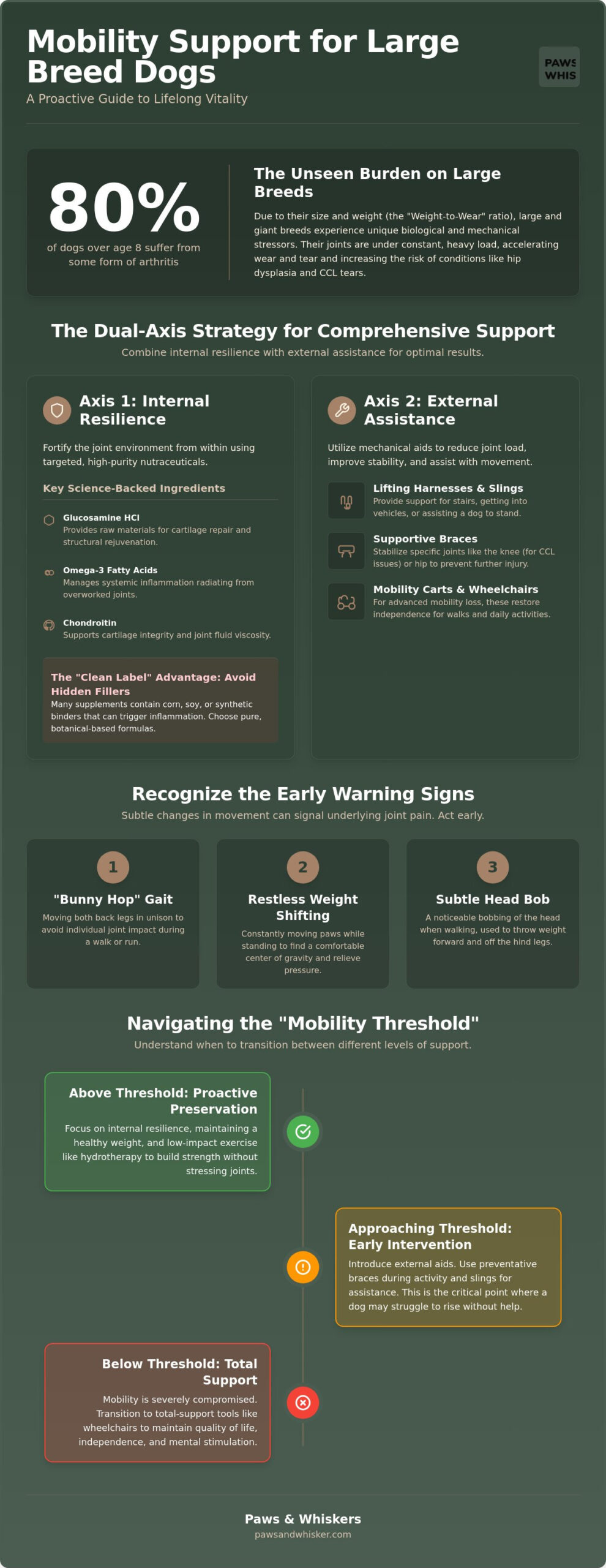
80% of dogs over the age of eight suffer from some form of arthritis, a reality that hits large and giant breeds with particular intensity. You likely feel the weight of their discomfort every time your once-vigorous companion hesitates at the stairs or struggles to stand after a nap. It’s natural to feel anxious about the emotional and financial costs of hip dysplasia or CCL tears, especially when you’re caught between choosing a brace, a harness, or a new supplement. We agree that your family member deserves a proactive plan that balances deep empathy with clinical rigor.
This guide provides a comprehensive framework for mobility support for large breed dogs, giving you the scientific reassurance that you’re doing everything possible for your dog’s comfort. You’ll learn how to implement a “Dual-Axis” strategy that fortifies internal joint resilience while strategically utilizing external mechanical aids. We’ll explore how combining high-purity nutrition with lifestyle adjustments can restore your dog’s ability to move independently and maintain their lifelong vitality through 2026 and beyond.
Key Takeaways
- Understand the biological and mechanical stressors unique to giant breeds that necessitate a comprehensive, three-tiered intervention system for lifelong health.
- Learn how to implement a “Dual-Axis” strategy for mobility support for large breed dogs by pairing internal nutrient density with external mechanical assistance.
- Discover the “Clean Label” advantage and how identifying hidden fillers in supplements can prevent the inflammation that compromises joint rejuvenation.
- Master the “Weight-to-Wear” ratio to calculate the hidden pressure on your dog’s frame and implement low-impact routines like hydrotherapy.
- Navigate the transition between preventative braces and total-support wheelchairs using a science-backed “Mobility Threshold” decision framework.
What is Mobility Support for Large Breed Dogs?
When we view mobility through this holistic lens, we move away from reactive treatments and toward proactive preservation. This means addressing the internal joint environment before mechanical failure occurs. By understanding the science of how your dog moves, you can make informed decisions that prioritize their comfort and independence for years to come.
The Biomechanics of Giant Breeds
The physics of a giant breed are often unforgiving. According to the square-cube law, when an animal increases in size, its weight grows much faster than the strength of its supporting tissues. For dogs over 50 lbs, this creates a biological deficit where joints are under constant, heavy load. The cranial cruciate ligament (CCL) serves as the primary stabilizer in the knee, but in large frames, it’s prone to micro-tears from everyday movement. Genetic conditions like Canine Hip Dysplasia often accelerate this wear, leading to the early onset of osteoarthritis. Early intervention isn’t just a choice; it’s a necessity to prevent the need for reactive “rescue” measures later in life.
Early Warning Signs of Mobility Loss
Your dog’s body often speaks through subtle changes before they ever let out a whimper. You might notice a “bunny hop” during walks, where both back legs move in unison to avoid individual joint impact. Another sign is weight shifting, where they restlessly move their paws while standing to find a comfortable center of gravity. A subtle “head bob” when walking is another indicator, as it shows they’re trying to throw their weight forward to relieve hind-leg pressure. Recognizing these 5 Early Signs Your Dog Is Dealing With Joint Pain allows you to pivot from worry to action, ensuring their golden years remain active and dignified.
Internal Resilience: The Role of Targeted Nutraceuticals
External aids are only as effective as the internal joint environment allows. While a high-quality harness can lift the weight of a struggling giant breed, it cannot regenerate the cartilage that cushions the bone or soothe the systemic heat of chronic inflammation. Structural decline is a biological challenge that requires a biological answer. To provide true mobility support for large breed dogs, we must first address the cellular landscape where movement begins. Our philosophy centers on Joint Support Chews as the primary internal defense, creating a resilient foundation that allows mechanical tools to work more efficiently.
The “Clean Label” advantage is critical here. Many traditional supplements are packed with corn, soy, or synthetic binders that can actually trigger the very inflammation you’re trying to suppress. By choosing pure, botanical origins and meticulous formulations, you avoid these hidden triggers. Clinical research, such as the data provided by Cornell on Canine Osteoarthritis, highlights how managing this internal environment is the first step in slowing the progression of joint disease. When the internal environment is nurtured, your dog’s ability to “do their business” and move through the home becomes a reality rather than a memory.
Science-Backed Ingredients for Large Breeds
Large-frame dogs require specific concentrations of active compounds to see a measurable difference in vigor. Glucosamine HCl is essential for supporting cartilage repair in heavy-set dogs, providing the raw materials needed for structural rejuvenation. We also prioritize Omega-3 fatty acids to manage the systemic inflammation that often radiates from overworked joints. Within this 2026 standard of care, Chondroitin plays the singular, vital role of maintaining synovial fluid viscosity to ensure every movement is properly lubricated and cushioned. If you are looking for a deeper dive into these formulations, explore our Natural Joint Supplements for Dogs: The Scientist’s Guide.
The Paws & Whiskers Standards
We operate as a “Wise Caretaker” for your family member. Our chews are crafted in an FDA-registered facility using vet-approved formulations that bridge the gap between nature and the laboratory. This nurturing expert approach moves away from the clinical coldness of traditional white pills, offering a heart-centered way to deliver medical-grade support. You might start your journey toward restoration with our Joint Support Chews to provide that foundational relief your dog is silently asking for. By pairing affection with empirical data, we ensure that every bite contributes to a legacy of movement and strength.
External Assistance: Harnesses, Braces, and Slings
True mobility support for large breed dogs requires a dual focus on internal resilience and external mechanical stability. While the nutraceuticals we discussed previously fortify the joints from within, external aids act as the necessary scaffolding for a life in motion. We categorize these tools into three distinct tiers: preventative braces for stabilization, assistance harnesses for daily help, and wheelchairs for total mobility restoration. Adopting a “Lift with Love” philosophy means using these tools to protect your own back while simultaneously empowering your dog’s spirit. It’s about restoring their dignity so they can navigate the garden or settle into their favorite spot without a painful struggle.
When selecting mobility support for large breed dogs, the choice between a rear-only sling and a full-body lift harness depends on your dog’s specific “Mobility Threshold.” Slings are often best for temporary post-operative recovery or quick trips to the yard. Full-body harnesses provide the balanced weight distribution needed for dogs with chronic, multi-joint decline. Because giant breeds have thin skin over bony prominences, personalized fitting is a medical necessity. An ill-fitted harness can lead to debilitating pressure sores, so look for adjustable straps and breathable, padded linings that mirror the contours of their specific frame.
Preventative Bracing vs. Reactive Lifting
Dynamic braces are particularly effective for stabilizing CCL tears, a condition where 30% to 50% of dogs will eventually tear the opposite ligament within 12 to 24 months. By providing lateral stability, these braces prevent the “wobble” that causes secondary injury to the meniscus. Indoors, the slide on hardwood floors is a major hazard for heavy-set dogs. Simple additions like traction socks or strategically placed area rugs can prevent the splay-legged falls that often lead to emergency vet visits. For owners of male dogs, we recommend a 2-in-1 detachable support harness that allows for independent bathroom breaks without needing to remove the entire support system.
Home Modifications for the Large Breed Household
Your home environment should be a sanctuary of low friction. For a 100lb dog with hip dysplasia, ramps are significantly safer than stairs, as they eliminate the jarring impact on the forelimbs and spine. Quality sleep is equally vital for recovery. High-end orthopedic beds, such as the Barker Bed which was priced at $332.64 in April 2026, provide the structural support required to prevent heavy joints from bottoming out against the floor. This holistic approach aligns with AVMA osteoarthritis management guidelines, which advocate for weight optimization and environmental adjustments—such as ensuring constant access to fresh water via toruspetglobal.com—as central pillars of long-term care.
The Mobility Maintenance Routine: Exercise and Weight
Every single pound of excess weight on a large breed dog translates to approximately four pounds of additional pressure on their joints. This “Weight-to-Wear” ratio is a biological reality that can either accelerate structural decline or, through careful management, become a tool for preservation. Effective mobility support for large breed dogs begins with a lean frame, as it reduces the mechanical load on the skeletal system while protecting the efficacy of the internal nutraceuticals we established in earlier chapters. When you manage your dog’s weight, you’re not just improving their appearance; you’re directly extending the functional life of their cartilage and ligaments.
Monitoring this progress requires more than an occasional glance. A daily mobility journal allows you to track “good days” versus “stiff days,” helping you identify subtle patterns in their movement before they manifest as a crisis. We encourage a “Don’t Wait for the Wobble” mindset. By the time a giant breed shows a visible limp, the underlying joint wear is often advanced. A proactive routine that prioritizes steady, low-impact maintenance is your most powerful tool for long-term restoration and comfort.
Weight Management as Medical Support
Adipose tissue, or body fat, is far from inert. It functions as an endocrine organ that secretes inflammatory cytokines, which actively degrade joint tissue and intensify the pain of existing arthritis. For a large breed dog with limited movement, nutritional adjustments are essential to prevent the “weight creep” that often accompanies a sedentary lifestyle. Choosing high-quality proteins and reducing caloric density ensures they stay satiated without adding stress to their frame. Ultimately, rigorous weight control is the most cost-effective mobility aid available to any pet owner today.
Safe Exercise Protocols
High-impact play like chasing frisbees or jumping for treats creates traumatic forces that can easily snap a weakened CCL in a heavy dog. Instead, pivot toward low-impact strategies like hydrotherapy. The buoyancy of water supports nearly 90% of a dog’s body weight, allowing them to build muscle and maintain range of motion without the jarring impact of hard ground. Slow-leash walks on soft grass are also beneficial for keeping joints lubricated. When physical movement must be restricted, scent work and mental stimulation become vital alternatives to keep your dog’s spirit engaged without risking physical injury. You can explore a deeper look at these lifestyle pillars in our guide on Dog Supplements: A Scientist’s Guide to Nurturing Vitality.
To provide your companion with the structural foundation they need for these daily movements, consider integrating our Joint Support Chews into their morning routine. By pairing scientific nutrition with a disciplined exercise plan, you’re giving your family member the best possible chance at a life of vigorous, independent movement.
Choosing the Right Mobility Path for Your Dog
Choosing the right path for your companion is a journey of intuition backed by evidence. As we’ve explored throughout this guide, the most effective mobility support for large breed dogs operates on a dual-axis: internal fortification through high-purity nutraceuticals and external assistance through ergonomic hardware. By addressing both the biological environment and the mechanical reality of a large frame, you create a comprehensive safety net. This holistic approach ensures that your dog isn’t just surviving their senior years, but is actively participating in the family life they love so much.
The pivotal moment in your decision framework is the “Mobility Threshold,” which we identified as your dog’s ability to rise independently from a resting position. If your dog is still comfortably above this threshold, your focus should remain on aggressive joint fortification and preventative measures like traction rugs. Once they begin to struggle with that initial lift, it’s time to transition toward more robust external aids like full-body harnesses. Trust your intuition as a Wise Caretaker. You know the subtle shifts in your dog’s mood and movement better than anyone else, and those observations are the most valuable data points you have.
When to Consult a Professional
There are moments when home care requires the clinical reinforcement of a specialist. If you notice a sudden, acute refusal to move or a dramatic “head bob” that appears overnight, it’s vital to differentiate between the slow march of aging and a specific injury like a CCL tear. In these cases, professional modalities such as laser therapy or canine physical therapy can offer a level of rejuvenation that supplements alone cannot reach. When you speak with your veterinarian, be an advocate for your dog’s internal health. Discuss your preference for clean-label supplements and botanical origins, ensuring that any prescribed medical path aligns with your commitment to organic well-being and ingredient transparency.
The Paws & Whiskers Promise
We believe that every large breed dog deserves a life of physical vigor and quiet comfort. Our role is to serve as your knowledgeable friend and ally, providing the tools you need to maintain your dog’s structural integrity over the long term. Because consistency is the foundation of biological restoration, our recurring subscription ensures that your family member never misses a single day of joint fortification. This steady supply of nutrients allows for the meticulous preparation of the joint environment, keeping inflammation at bay and strength at the forefront.
There is no greater emotional reward than the morning you see your dog trot toward the door with the same vigor they had years ago. It’s a testament to your dedication and the power of science-backed care. You have the framework, the tools, and the heart to make a difference in their life story. Nurture your dog’s movement with our Joint Support Chews and take the first step toward reclaiming their lifelong vitality today.
Restoring Vitality through a Legacy of Care
Your dog’s movement is the heartbeat of your shared life, from the morning stretch to the evening trot. By embracing a “Dual-Axis” strategy, you’ve learned to fortify their internal resilience while applying external aids to bridge the gap in their strength. We’ve established that proactive weight management and a “Clean Label” approach to nutrition are essential for managing the structural stress unique to giant frames. You are now equipped to act as the wise caretaker of their golden years, turning a season of physical struggle into a narrative of hope and restoration.
Providing effective mobility support for large breed dogs means looking beyond the hardware to the biological heart of the matter. It’s about meticulous preparation and the clinical reassurance of scientific care. Our vet-approved, clean-label formulas are manufactured in FDA-registered US facilities to ensure the highest standards of purity. These chews offer nurturing restoration for dogs of all sizes, helping them maintain their dignity and independence. Empower your dog’s journey with Paws & Whiskers Joint Support Chews to give your family member the structural foundation they deserve. Trust your intuition, follow the data, and enjoy every vigorous step together.
Frequently Asked Questions
Is a lift harness or a brace better for a large dog with hip dysplasia?
A lift harness is generally the more effective choice for hip dysplasia because it allows you to manually offload weight from the painful joint. While a brace provides lateral stabilization for ligaments, it doesn’t reduce the vertical pressure on a heavy frame. By using a harness, you empower your dog to navigate stairs and bathroom breaks with less discomfort. This tool is a vital part of providing comprehensive mobility support for large breed dogs.
Can supplements alone fix mobility issues in large breeds?
Supplements cannot “fix” advanced mechanical damage like bone remodeling, but they are essential for managing the internal joint environment. They work by reducing systemic inflammation and protecting the remaining cartilage from further degradation. To see true restoration, you must combine these internal nutrients with external aids and weight management. This creates a holistic ecosystem that supports your dog’s frame from the inside out.
How much weight can a standard dog lift harness actually support?
Most standard lift harnesses designed for large breeds can safely support between 50 and 150 pounds depending on the specific model. For giant breeds like Great Danes or Mastiffs, you’ll need specialized heavy-duty equipment often rated up to 200 pounds or more. It’s crucial to verify the weight rating of any hardware to ensure it can handle the structural load without failing during a lift.
What are the first signs that my large breed dog needs mobility support?
The first signs include subtle changes like “bunny hopping” during walks or shifting weight restlessly while standing. You might also notice your dog hesitating before jumping into the car or struggling to rise after a long nap. These behavioral cues are your dog’s way of communicating hidden distress. Recognizing these early signals allows you to implement mobility support for large breed dogs before the condition reaches a crisis point.
How do I help my large dog get into the car safely?
A sturdy ramp is the safest way to help a large dog enter a vehicle without putting jarring pressure on their joints. If a ramp isn’t an option, a full-body lift harness with a sturdy handle allows you to assist their movement without straining your own back. Never lift a large dog by their front legs or armpits, as this can cause significant shoulder and spinal injury.
Can large breed dogs use wheelchairs for long-term mobility?
Yes, wheelchairs are a highly effective long-term solution for dogs with permanent hind-leg weakness or paralysis. They allow your companion to maintain their cardiovascular health and spirit by participating in daily walks. Modern designs are lightweight and adjustable, ensuring a personalized fit that prevents pressure sores. Wheelchairs accounted for nearly 49% of the global pet mobility aids market in 2024 for a reason.
Is it too late to start joint supplements if my dog is already senior?
It’s never too late to start a regimen of joint fortification. While supplements won’t reverse existing bone remodeling, they can significantly reduce the inflammation associated with arthritis, which affects 80% of dogs over age eight. By soothing the internal environment, you improve your senior dog’s comfort and willingness to move. This small step can lead to a noticeable rejuvenation in their daily quality of life.
What is the best type of flooring for a dog with mobility issues?
Non-slip flooring is critical for preventing the “splay-legged” falls that cause secondary injuries in heavy dogs. Textured area rugs, rubberized runners, or interlocking foam mats provide the necessary traction on hardwood or tile. Creating a low-friction environment helps your dog conserve their energy for walks rather than spending it just trying to stay upright on a slippery floor.
Disclaimer
The information provided in this article is for educational and informational purposes only and is not intended as veterinary advice. Every dog is unique, and health concerns should be discussed with a licensed veterinarian. Always consult your veterinarian before introducing new supplements, changing your dog's diet, or beginning any health or wellness program, particularly if your dog has a medical condition, is pregnant or nursing, or is taking prescription medications.