

What if the answer to your dog’s relentless scratching isn’t found in a pill bottle, but in the same botanical world that has supported immune health for centuries? If you’ve watched your dog claw at their skin until it’s raw, you already know the heartbreak that comes with it. And if you’ve tried conventional antihistamines only to find your pup drowsy, lethargic, and still itching by morning, your instinct to look for something better is absolutely right.
The truth is, a natural antihistamine for dogs isn’t just a gentler swap for Benadryl. The most effective botanical options work differently from synthetic drugs; they help calm the immune system’s overreaction at its source rather than simply masking the symptoms downstream. That’s a meaningful distinction, and it’s one that more pet owners and veterinary professionals are taking seriously.
In this guide, you’ll get a clear, science-informed look at which natural compounds have genuine evidence behind them, how they work inside your dog’s body, and how to build a long-term wellness plan that supports a calmer immune response from the inside out.
Key Takeaways
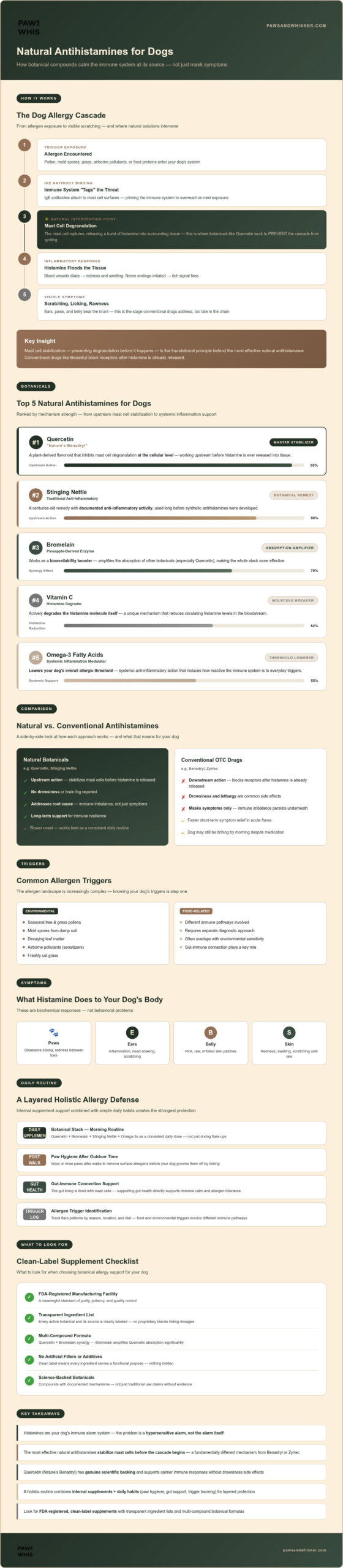
- Histamines are signaling molecules released by mast cells during an allergic flare — understanding this “alarm system” is the first step toward addressing your dog’s itching at its source, not just masking it.
- The most effective natural antihistamine for dogs works by stabilizing mast cells before they trigger an inflammatory response, offering a fundamentally different mechanism than conventional OTC medications like Benadryl or Zyrtec.
- Botanical compounds, including quercetin — often called “Nature’s Benadryl” — carry genuine scientific backing and can support calmer immune responses without the lethargy and brain fog commonly seen with chemical antihistamines.
- A holistic allergy routine combines internal supplement support with simple daily habits like post-walk paw hygiene, creating a layered defense against environmental allergens your dog encounters every day.
- Clean-label supplements manufactured in FDA-registered facilities offer a meaningful standard of purity and potency — and you’ll learn exactly what to look for when choosing botanical allergy support for your dog.
Understanding Histamines and Your Dog’s Immune Response
Your dog isn’t just itchy. That relentless scratching, the angry pink skin, the obsessive licking at paws and belly — these are the visible signs of something happening much deeper inside. Histamines are signaling molecules produced naturally within your dog’s body, and under normal circumstances, they serve a genuinely useful purpose: alerting the immune system to potential threats. The problem begins when that alarm system becomes hypersensitive, firing repeatedly in response to things that pose no real danger, like a gust of spring pollen or a patch of freshly cut grass.
When histamine floods the tissue, the results are unmistakable. Blood vessels dilate, causing redness and swelling. Nerve endings become irritated, triggering the itch signal that sends your dog into a frantic scratching spiral. The skin around the ears, paws, and belly often bears the brunt of it. What you’re witnessing isn’t behavioral — it’s biochemical. Your dog is experiencing a genuine internal immune imbalance, and that distinction matters enormously for how you approach relief.
The Mast Cell Connection
At the center of every allergic flare is a specialized immune cell called a mast cell. These cells are stationed throughout your dog’s body — in the skin, the gut lining, and the respiratory tract — acting as sentinels. When your dog has been sensitized to a particular allergen, their immune system produces IgE antibodies that attach to the surface of these mast cells. The next time that allergen appears, it binds to those IgE antibodies and triggers a process called degranulation: the mast cell essentially ruptures, releasing a concentrated burst of histamine directly into the surrounding tissue. That release is what ignites the inflammatory cascade. Mast cell stabilization — preventing that degranulation from occurring in the first place — is the foundational principle behind the most effective natural antihistamine for dogs.
Common Triggers in 2026
The allergen landscape has grown increasingly complex. Environmental triggers now include seasonal tree and grass pollens, mold spores from damp soil and decaying leaves, and a growing body of airborne pollutants that can sensitize immune systems over time. It’s also important to distinguish between environmental histamine responses and food sensitivities, which involve different immune pathways and often require separate strategies to address.
This complexity is exactly why genuine allergy relief for dogs requires a multi-faceted approach rather than a single-ingredient fix. Identifying your dog’s specific triggers, supporting the gut-immune connection, and calming the mast cell response at its source all work together — and that’s the framework this guide is built around.
Top 5 Natural Antihistamines for Dogs: The Power of Botanicals
Nature has been quietly solving the histamine problem for centuries. Long before synthetic antihistamines existed, botanical compounds were doing something far more elegant than blocking histamine receptors after the fact. The most effective natural antihistamines for dogs work upstream, stabilizing the mast cells themselves so the inflammatory cascade never fully ignites. That’s a fundamentally different strategy from what you’ll find in a blister pack of Benadryl, and it’s why these compounds deserve serious attention.
Here are the five botanical and nutritional compounds with the most meaningful science behind them.
- Quercetin: A plant-derived flavonoid that inhibits mast cell degranulation at the cellular level
- Stinging Nettle: A traditional remedy with documented anti-inflammatory activity
- Bromelain: A pineapple-derived enzyme that amplifies the absorption of other botanicals
- Vitamin C: A nutrient that actively degrades the histamine molecule itself
- Omega-3 Fatty Acids: Systemic inflammation modulators that lower your dog’s overall allergic threshold
Quercetin: The Master Stabilizer
Quercetin earns its nickname, “Nature’s Benadryl,” but the comparison undersells it. While Benadryl blocks histamine receptors after histamine has already been released, quercetin acts earlier in the process, inhibiting the release itself by stabilizing mast cell membranes. Research into quercetin’s mechanism shows it suppresses the signaling pathways that trigger degranulation, meaning less histamine floods the tissue in the first place. It also carries meaningful antioxidant activity, helping to neutralize the oxidative stress that often accompanies chronic inflammatory states in the skin.
Sourcing matters enormously here. Low-purity quercetin preparations may contain fillers or degraded compounds that reduce efficacy and introduce unnecessary variables for a dog’s digestive system. High-purity quercetin, verified through clean-label manufacturing standards, is what makes the difference between a supplement that performs and one that simply looks good on a label. Quercetin is often the cornerstone of quality dog supplements formulated specifically for allergy and immune support, precisely because no other single botanical addresses the mast cell problem as directly.
Stinging nettle complements quercetin well. Traditional herbalists have used it for respiratory and skin inflammation for generations, and more recent investigation has focused on its ability to reduce key inflammatory markers associated with allergic responses, making it a practical partner in a multi-compound formulation.
Bromelain’s role is often underestimated. This enzyme, extracted from pineapple, doesn’t carry strong antihistamine activity on its own. What it does is enhance the bioavailability of quercetin and other botanicals taken alongside it, helping more of the active compound reach systemic circulation rather than being lost in digestion.
Vitamin C rounds out the internal picture. Unlike the compounds above, it works by enzymatically breaking down histamine molecules that are already circulating, adding a complementary layer of support to the mast cell stabilization happening upstream.
The Role of Omega-3 Fatty Acids
EPA and DHA, the long-chain omega-3 fatty acids, address the allergic response from a different angle entirely. Rather than targeting histamine directly, they reduce the body’s overall inflammatory tone, effectively lowering the threshold at which your dog’s immune system fires. A dog with a well-supported inflammatory system is simply less reactive to the same allergen load that would previously trigger a full flare.
There’s also a structural benefit worth understanding. Omega-3s are incorporated into the phospholipid membranes of skin cells, improving the integrity of the skin barrier itself. A stronger barrier means fewer environmental allergens penetrating the skin and reaching the mast cells waiting beneath it. It’s a physical defense that works in direct synergy with the internal botanical support described above.
For long-term maintenance, clean-label Omega-3 soft chews offer a practical, consistent delivery format that most dogs accept readily. If you’re building a layered allergy support routine, Paws and Whisker’s Skin & Coat Omega-3 Soft Chews are worth exploring as a complement to a botanical allergy formulation, providing that structural skin support alongside the immune-calming work happening internally.
Natural Remedies vs. Conventional Antihistamines
There’s a reason so many dog owners reach for Benadryl first. It’s familiar, it’s cheap, and it works fast enough to feel like progress. But “fast” and “effective” aren’t the same thing, and understanding that distinction is what separates reactive symptom management from genuine immune support.
Conventional OTC antihistamines like diphenhydramine (Benadryl) and cetirizine (Zyrtec) work by occupying histamine receptors so that circulating histamine can’t bind to them. That’s a downstream intervention. The mast cells have already degranulated, the histamine has already flooded the tissue, and the medication is simply trying to limit the damage after the fact. It’s firefighting, not fire prevention.
The practical consequences show up quickly. Diphenhydramine crosses the blood-brain barrier, which is why dogs on it often appear sedated, disoriented, or uncharacteristically flat in their personality. That “brain fog” isn’t a minor inconvenience; it’s a sign that the drug is acting systemically on the central nervous system, not just at the site of inflammation. For a dog who is already uncomfortable, trading itching for lethargy isn’t a meaningful win.
Then there’s the rebound effect, which rarely gets discussed but matters enormously for long-term management. When conventional antihistamines are stopped abruptly, the immune system often overcorrects. Histamine receptors that were blocked become hypersensitive, and symptoms can return with greater intensity than before. This cycle, where relief is temporary and withdrawal makes things worse, is one of the primary reasons pet owners find themselves stuck in a loop of escalating medications rather than genuine resolution.
A natural antihistamine for dogs approaches the problem from the other direction entirely. Botanical compounds work proactively, supporting the immune system before the inflammatory cascade begins rather than scrambling to contain it afterward.
When to Choose Natural Support
Botanical support is particularly well-suited for dogs with seasonal sensitivities or mild-to-moderate environmental allergies. Because compounds like quercetin and stinging nettle work cumulatively, building a calmer immune baseline over time, they’re most effective when introduced before peak allergy season rather than during an acute flare. Critically, they don’t place the same metabolic burden on the liver and kidneys that long-term pharmaceutical use can. For dogs already on a total wellness stack that includes joint supplements for dogs, adding botanical allergy support is a natural extension of the same proactive philosophy.
The Limitations of OTC Medications
Beyond the rebound effect, human-grade antihistamines carry a specific safety risk that deserves a direct warning: some formulations contain xylitol, an artificial sweetener that is acutely toxic to dogs. Even products that don’t contain xylitol may include inactive fillers, dyes, or decongestant combinations that are unsafe for canine physiology. This is why vet-approved, canine-specific formulations matter. They’re not just a marketing preference; they reflect a fundamentally different standard of safety. Human medications are optimized for human biochemistry, and assuming they translate cleanly to dogs is an assumption that can cause real harm.
Integrating Holistic Support into Your Dog’s Daily Routine
Supplements alone won’t close the loop. The most meaningful allergy relief comes from pairing internal botanical support with deliberate daily habits that reduce the allergen load your dog encounters from the moment they step outside. Think of it as a two-front strategy: calm the immune system from within while systematically reducing what triggers it from without. This synergy is precisely what most single-focus approaches miss, and it’s where real, lasting comfort is built.
Diet is a quiet contributor that rarely gets enough attention. Many commercial kibbles contain high-histamine filler ingredients, including certain protein meals, artificial preservatives, and fermented by-products, that can quietly elevate your dog’s baseline histamine load before a single pollen grain enters the picture. Reading ingredient panels critically and choosing foods with clean, identifiable protein sources removes an unnecessary burden from an immune system that’s already working overtime.
There’s also the itch-scratch-stress cycle to consider. Chronic itching elevates cortisol, and elevated cortisol can amplify immune reactivity, creating a feedback loop that makes existing sensitivities worse. Simple calming techniques, including structured rest periods, enrichment activities that redirect anxious energy, and consistent routines that reduce environmental unpredictability, can meaningfully interrupt that cycle. A calmer dog is, biochemically speaking, a less reactive one.
The Supplement Schedule
Botanical compounds like quercetin and stinging nettle aren’t designed to work like an emergency brake. They build efficacy over time by gradually stabilizing mast cell behavior and lowering systemic inflammatory tone. Consistency is the mechanism. Skipping days interrupts the accumulation period and resets the baseline you’ve been working to establish. For dogs entering a severe seasonal transition, a brief loading period under veterinary guidance can help establish that baseline more quickly. Ideally, start natural antihistamine for dogs support two to four weeks before your local allergy season peaks, giving the botanical compounds time to work before the allergen pressure arrives.
Environmental Management
After every walk, a quick paw rinse removes the environmental allergens your dog has literally walked through. A simple solution of water with a small amount of white vinegar, applied with a soft cloth or shallow soak, is effective and gentle on skin. Rinse thoroughly and dry completely to prevent moisture buildup between the toes.
Inside the home, HEPA air filtration meaningfully reduces airborne pollen, mold spores, and dust particles that settle on your dog’s coat and skin. Washing your dog’s bedding weekly in hot water eliminates the allergen reservoir that builds up between baths.
One practical distinction worth knowing: a hot spot is a localized, moist, rapidly spreading skin lesion that typically requires veterinary attention, while a general histamine reaction tends to present as diffuse redness, widespread itching, and paw licking across multiple body areas. Confusing the two can lead to the wrong intervention.
Building these habits alongside a consistent supplement routine creates the layered defense that neither approach achieves alone. Explore Paws & Whisker’s Allergy & Immune Support Chews as the internal foundation your daily routine is built around.
Why Nurturing Immune Resilience Starts with Clean-Label Care
Botanical ingredients are only as good as the standards behind them. A quercetin capsule sourced from an unverified supplier can carry pesticide residues, heavy metal contamination, or degraded compounds that quietly undermine everything you’re trying to accomplish. This is the gap that most general herbalism advice never addresses, and it’s where the difference between a supplement that delivers and one that disappoints is actually decided.
Paws & Whiskers builds every formulation around a clean-label philosophy that removes the guesswork entirely. No corn. No soy. No hidden fillers or artificial binders that add volume without adding value. What’s on the label is what’s in the chew, and nothing else. That transparency isn’t a marketing angle; it’s a formulation discipline that shapes every sourcing and manufacturing decision the brand makes.
The Paws & Whiskers Difference
All Paws & Whiskers supplements are manufactured in US-based, FDA-registered facilities, which means every production batch operates under documented quality controls covering ingredient identity, potency verification, and contamination screening. That standard matters because the supplement industry, including the pet supplement category, is not uniformly regulated. Choosing a product made outside of an FDA-registered environment is genuinely a different risk calculation than choosing one made within it.
The formulation philosophy here is what the brand calls a “nurturing expert” approach: effective, but never harsh. The Allergy & Immune Support Chews are designed to work synergistically, pairing mast cell-stabilizing botanicals with complementary compounds that enhance absorption and extend the window of immune support throughout the day. This isn’t a single-ingredient product dressed up with filler. It’s a considered stack built around the biology of the allergic response. When paired with the Skin & Coat Omega-3 Soft Chews for structural skin barrier support, the two products address the allergy problem from both the inside and the surface simultaneously.
Joining the Paws & Whiskers community means more than choosing a supplement. It means aligning with a mission-driven approach to pet wellness that treats your dog as a full family member deserving the same ingredient integrity you’d expect in your own nutrition.
Starting Your Dog’s Journey to Relief
If your dog is currently on a conventional antihistamine, don’t stop it abruptly. Introduce botanical support alongside the existing medication, then work with your veterinarian to taper the pharmaceutical as the natural antihistamine for dogs builds its baseline effect over two to four weeks. Gradual transitions protect against the rebound sensitivity described earlier in this guide.
A recurring subscription ensures your dog never misses a dose during the accumulation period when consistency matters most. Gaps interrupt the progress you’ve built, and restocking gaps are the most common reason botanical protocols underperform.
Restoration is genuinely possible. Nature and science, working together through clean, rigorously manufactured formulations, can give your dog back the comfortable, unbothered life they deserve. That’s not a promise made lightly. It’s the foundation every Paws & Whiskers product is built on.
Your Dog Deserves More Than Symptom Management
Watching your dog scratch and suffer doesn’t have to be your new normal. The framework in this guide points toward something genuinely different: addressing the allergic response at its root rather than chasing symptoms after they’ve already taken hold. A consistent natural antihistamine for dogs routine, built around mast cell-stabilizing botanicals and smart daily habits, creates the kind of cumulative immune resilience that one-off antihistamine doses simply can’t deliver.
The key principles worth carrying forward: botanical compounds work best when started early and taken consistently; environmental management multiplies the effect of internal support; and clean-label manufacturing standards aren’t optional when your dog’s health is the outcome you’re protecting.
Over 2,000 pet parents have already made the switch to a more thoughtful approach to allergy care. Vet-approved, free of hidden fillers, and made in US-based FDA-registered facilities, Paws & Whiskers formulations are built to earn that trust. Nurture your dog’s immune health with our science-backed Allergy & Immune Support Chews. Comfortable, unbothered days are genuinely within reach.
Frequently Asked Questions About Natural Antihistamines for Dogs
Can I give my dog human Benadryl as a natural alternative?
Human Benadryl isn’t a natural alternative; it’s a synthetic antihistamine that works by blocking histamine receptors after an inflammatory response has already started. While diphenhydramine is sometimes used in dogs at a vet-approved dose, human formulations carry real risks. Some products contain xylitol, which is acutely toxic to dogs, and others include decongestant combinations that are unsafe for canine physiology. A genuinely natural approach uses botanical compounds that support the immune response upstream, before histamine floods the tissue.
How long does it take for natural antihistamines to start working?
Unlike pharmaceutical antihistamines that produce effects within an hour, botanical compounds like quercetin and stinging nettle work cumulatively. Most dogs show meaningful improvement after two to four weeks of consistent daily use, as these compounds gradually stabilize mast cell behavior and reduce baseline inflammatory tone. This is why starting a natural antihistamine for dogs routine before peak allergy season matters so much; waiting until a flare is already underway means working against a head start the allergens already have.
Are there any side effects to using quercetin or nettles for dogs?
Both quercetin and stinging nettle are generally well-tolerated in dogs when used at appropriate doses in clean-label formulations. Occasionally, dogs with sensitive digestive systems may experience mild gastrointestinal upset when first introduced to botanical supplements; starting with a smaller amount and gradually increasing can help. The more meaningful risk comes from low-quality sourcing: impure quercetin preparations may contain contaminants or degraded compounds that introduce unnecessary variables. Choosing a vet-approved supplement manufactured in an FDA-registered facility significantly reduces that risk.
Can natural antihistamines be used alongside prescription allergy medications?
In most cases, yes, but always with veterinary guidance. Botanical compounds like quercetin don’t typically interact with common prescription allergy medications, and many integrative veterinarians actively recommend a transitional approach: introduce botanical support alongside the existing prescription, then taper the pharmaceutical gradually as the natural baseline builds over two to four weeks. Stopping prescription medications abruptly can cause rebound hypersensitivity, so a supervised, gradual transition is the safest path forward.
What is the best natural antihistamine for a dog with seasonal skin allergies?
For seasonal skin allergies specifically, a combination approach tends to outperform any single ingredient. Quercetin addresses mast cell stabilization internally, while omega-3 fatty acids strengthen the skin barrier physically, reducing how many environmental allergens penetrate the skin and reach immune cells beneath it. Pairing a botanical allergy formulation like Paws & Whiskers’ Allergy & Immune Support Chews with their Skin & Coat Omega-3 Soft Chews targets the problem from both directions simultaneously, which is where lasting seasonal relief is actually built.
Is apple cider vinegar actually an antihistamine for dogs?
Apple cider vinegar is a popular home remedy, but there’s no credible scientific evidence supporting it as a true antihistamine for dogs. It doesn’t stabilize mast cells, block histamine receptors, or degrade circulating histamine molecules. Some pet owners report mild topical relief from diluted applications on irritated skin, likely due to its mild antimicrobial properties rather than any antihistamine mechanism. Relying on it as a primary allergy intervention means missing the actual immune-level support your dog needs.
How much quercetin should I give my dog per day?
A commonly referenced starting point in veterinary literature is approximately 5 to 10 milligrams per kilogram of body weight, given twice daily, but this varies depending on formulation purity, the presence of bioavailability enhancers like bromelain, and your dog’s individual health status. Rather than calculating raw dosing independently, the most reliable approach is to follow the weight-based dosing guidelines on a vet-approved supplement, where the formulation has already been calibrated for canine physiology. Always confirm with your veterinarian before introducing any new supplement regimen.
Can probiotics act as a natural antihistamine for canine allergies?
Probiotics don’t function as direct antihistamines, but they support the gut-immune axis in ways that meaningfully influence allergic reactivity. A significant portion of your dog’s immune system resides in the gut lining, and a well-balanced microbiome helps regulate how aggressively the immune system responds to environmental triggers. Think of probiotic support as foundational groundwork: it doesn’t replace mast cell-stabilizing botanicals, but it creates a more balanced internal environment in which those compounds can do their job more effectively.

Disclaimer
The information provided in this article is for educational and informational purposes only and is not intended as veterinary advice. Every dog is unique, and health concerns should be discussed with a licensed veterinarian. Always consult your veterinarian before introducing new supplements, changing your dog's diet, or beginning any health or wellness program, particularly if your dog has a medical condition, is pregnant or nursing, or is taking prescription medications.